The 5 Cycling Pains That Disappear With a Bike Fit (and the Ones That Don't)

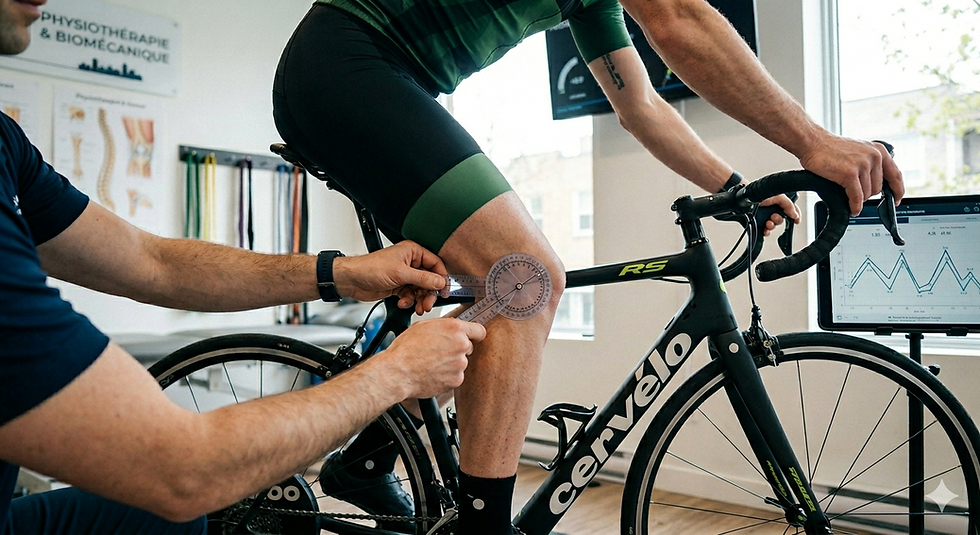
Last season, you finished several rides with that knee that was pulling, that back that was complaining, or those hands going numb after an hour. You told yourself you'd deal with it in the fall. Fall came and went. Now spring is back: the bike paths are clearing up, the bike is coming out of the garage, and you don't want it to start again.
Someone suggested a bike fit. Good idea?
Honest answer: often yes, but not always a magic fix. And understanding the difference is exactly what keeps you from repeating the same painful season, or wasting time looking for a solution in the wrong place.
One important clarification right off the bat: we're talking about a bike fit performed by a physiotherapist, not a simple adjustment at a bike shop. The difference is that the physio evaluates both sides at once: the bike and the body powering it.
In this article: · The 5 cycling pains that respond well to a bike fit · What a bike fit can't fix on its own · How to tell what's coming from your bike vs. from you
A useful first clue before reading on: if your pain shows up only on the bike, it has a much better chance of responding to a position adjustment. If it's also present in your daily life, while walking, or in other sports, the cause is probably elsewhere and a bike fit alone won't cut it. It's not an absolute rule, but it's a good starting point to guide your thinking.
The 5 Pains That Often Disappear With a Bike Fit
1. Knee Pain (Front of the Knee)
This is the number one complaint among cyclists. A diffuse pain under or around the kneecap that gradually sets in after 45–60 minutes of riding, or when returning after a break.
The position link: A saddle that's too low forces the knee to work in excessive flexion with every pedal stroke. Over a few hours of riding, that's thousands of repetitions with increased joint stress. Raising the saddle by a few millimeters can completely transform the situation.
Other positional factors also play a role: the position of the cleats on your shoes (often overlooked!), the saddle-to-handlebar distance, and the saddle tilt itself.
2. Lower Back Pain
The lower back is the other classic complaint, especially in road cyclists or mountain bikers who spend hours in a flexed position.
The position link: A handlebar that's too low or too far away forces the lumbar spine to curve beyond what it can tolerate over time. A poorly tilted saddle (too far forward) or poorly positioned saddle causes the pelvis to tilt and compresses the lower back. Adjusting these parameters often dramatically reduces pain, without anything actually being "broken" in your back, by better distributing the load.
3. Hand and Wrist Numbness
Tingling in your fingers after 30 minutes on the bike? Hands going numb on long descents?
The position link: When too much weight is shifted onto the hands (handlebar too low, saddle tilted too far forward, wrong stem length), the wrists and ulnar or median nerves bear the consequences. A readjustment of weight distribution can fix this problem in a single session.
4. Neck and Shoulder Pain
This one often shows up after long rides, or when you start riding in a more aggressive position (time trial, tri, road bike with low drops).
The position link: An overly stretched-out position forces the neck extensors to work in prolonged static contraction to keep the head up. It's exhausting. And painful. Raising the handlebar or shortening the stem can significantly relieve the cervical region.
5. Perineal Discomfort and Saddle Pain
This is the topic people talk about less, but that many quietly experience: genital numbness, pain at the base of the perineum, a lingering feeling of discomfort after a ride.
The position link: A poorly chosen or poorly oriented saddle (tilted too far down, too high,
poorly positioned in depth) puts direct pressure on the vascular and nerve structures of the perineum. A bike fit includes a saddle assessment, and sometimes simply changing the angle by a few degrees is enough. The physiotherapist will also be able to guide you in choosing the right saddle if yours really isn't appropriate for you.
The Pains That DON'T Disappear With a Bike Fit Alone
This is where clinical honesty comes in.
A bike fit optimizes your position on the bike. But if the problem comes from you — a muscle weakness, an existing injury, an irritated structure — adjusting the bike won't fix the root cause. At best, it reduces the irritation. At worst, it delays the real treatment.
In practice, three main situations signal that more than a bike adjustment is needed.
The pain is present off the bike. If you also feel it while walking, at work, or in another sport, it probably existed before the position became a problem. The bike fit can help keep it from getting worse on the bike, but it won't treat the source.
There's an active injury or inflammation. A tendinitis, a recent sprain, an irritated lumbar condition: the body needs care first. Optimizing position on already inflamed tissue won't work miracles.
There's a significant physical limitation. If an ankle stiffness prevents you from reaching a good pedaling position, or if the muscles powering the bike aren't strong enough to sustain the effort, adjusting the bike won't compensate in the long run. You need to address that mobility or strength first.
This is precisely where a physiotherapy bike fit makes all the difference. When a limitation comes from the body rather than the bike, the physiotherapist can directly follow up: mobilizing an ankle that lacks range of motion, prescribing a strengthening program for the glutes or stabilizers, or treating a tendinitis alongside the position adjustment. You don't leave with a well-adjusted bike and an unresolved problem: both are addressed within the same treatment plan.
And the bike fit, contrary to what you might think, isn't set in stone. You can start with a more conservative position that respects the person's current capacities, then progressively adjust as mobility and tolerance improve. It's a progressive approach: the position adapts to progress, not the other way around.
The Real Value of a Bike Fit: Prevention as Much as Treatment
Even if you have no pain today, a bike fit remains a smart investment at the start of the season. Most cycling injuries don't happen from a fall or a specific incident: they accumulate slowly, repetition after repetition, from a slightly suboptimal position.
A bike fit performed by a physiotherapist goes beyond a simple mechanical adjustment: it takes into account your morphology, your mobility, your history, and your goals. The ideal position for a triathlete who wants to preserve their back for the run isn't the same as that of a climber who wants to maximize power.
In Summary
These pains respond well to a bike fit:
Knee pain (front of the knee)
Lower back pain
Hand and wrist numbness
Neck and shoulders
Perineal discomfort and saddle pain
These situations require more than a position adjustment:
Active tendinitis or injury: treatment comes first
Pre-existing lumbar condition (herniation, stenosis): the bike fit complements, but isn't enough on its own
Significant muscle weakness: strengthening first, bike fit after (or alongside)
Pain present off the bike: the cause is elsewhere
Do you recognize yourself in one of these situations? The next step is an assessment, to distinguish what's coming from your bike and what's coming from you.
*Image generated by AI
Philippe Dessaulles-Goudezeune is a physiotherapist and member of the OPPQ, with expertise in cycling biomechanics and running. He offers bike fits in Montreal (Griffintown / Pointe-Saint-Charles) and teaches at Université de Montréal.

